 |
 |
 |
 |




 |
||||||||||||||||||||
|
||||||||||||||||||||
 |
||||||||||||||||||||




PRODUCTSARTEFACTS MADE OF PRECIOUS METALS Generally speaking, when we think of the goldsmith's art we think of ornamental goods where gold is the main component. In jewellery the price of a piece, apart from the costs of design and manufacture, is made up of precious stones. Jewellery is based on hand crafted techniques, the quality of the piece being based on the skill and creativity of the artisan. Our production is realised without the use of machines, and as a result, what is produced has a unique style. FIBULAE The fibulae are personal ornaments belonging to the first Iron Age (X - IX - VIII sec. b.C.). They were used as ornamental buttons for clothing. The fibulae of this period are made of bronze and they are divided in: - double spiral fibulae - arched fibulae NECKLACES The handmade necklaces are made through by employing techniques of boring (using a small saw) or embossing (creating bass-reliefs). EARRINGS The earrings are made by employing the ancient technique of the granulation. This involves the fusion of metals, resulting in the creation of different-sized granules. These granules are then integrated into the design of the particular earring being decorated. The hangings are made using the granulation technique, or through the soldering on of previously-manufactured metal pieces.
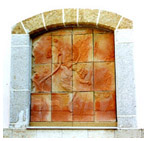
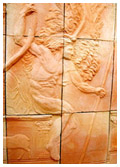
PRODUCTS MADE OF CLAY The natural elements, including earth and fire are for man, a genetic memory. This memory contains the history and the culture of a population. The ways of working clay by hand, and subsequent firing remain unchanged since ancient time. The characteristics of the clay depend on the way it's produced. The colours of the clay are very diverse depending on the place where the clay has been extracted. Clay pieces are fired using wood-fired kilns, and this results in subtle and original nuances to the final colour, ranging from yellow to an opaque pink. Each piece is, therefore, completely unique and beautiful in its own right. The pieces are based on ceramics from the Daunian period. The style of Daunian ceramics is one that uses a geometric decoration produced in the north part of Puglia region, from the beginning of VII sec. b.C. until the end of IV sec. b.C. Pieces are made by using the wheel. The expert artisan always supervises the working process and the pieces are decorated with natural pigments. In order to keep to natural and ancient traditions, firing the pottery is undertaken using wood-fired kilns. The panels in bas-reliefs are made up of more or less regular blocks. They are later mounted on rigid wooden supports or directly onto the wall. Some reproductions could present decorations.
|